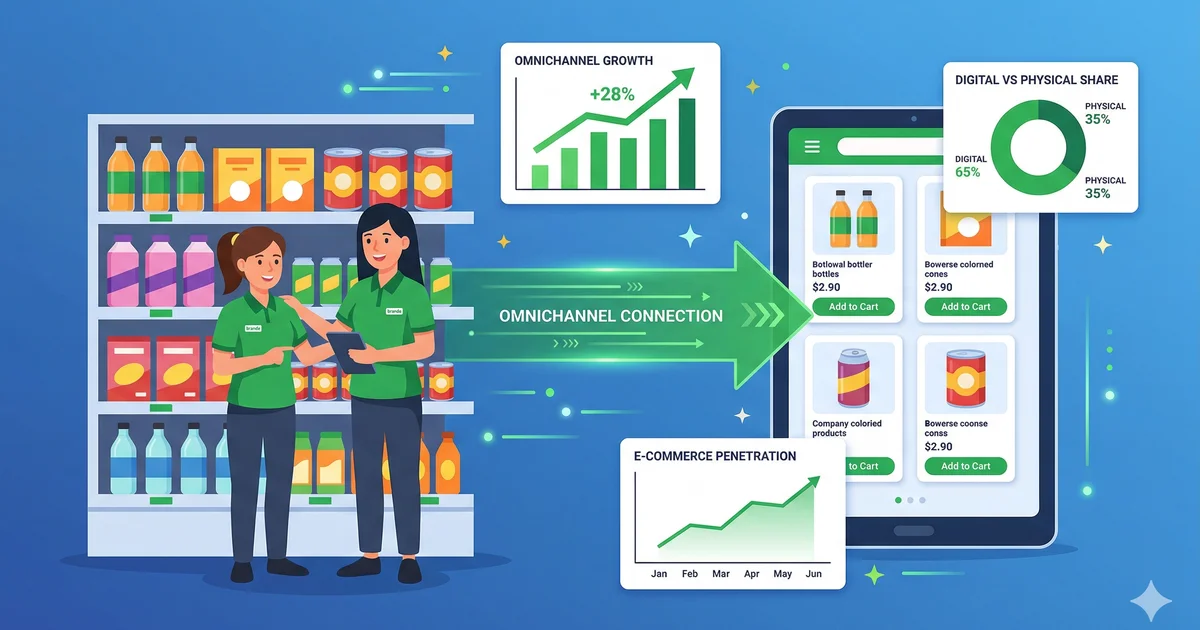
For two decades, trade marketing was defined by physical space , shelf positioning, planogram compliance, in-store displays and field team management. Then e-commerce arrived, grew from a niche channel to the fastest-expanding retail format in the world, and forced every brand to rethink what "the point of sale" actually means.
Today, the point of sale is everywhere: a product page on Amazon, a sponsored placement in a grocery app, a QR code on a physical shelf that triggers an online promotion, a click-and-collect order fulfilled from a store that a field rep visited that morning. Trade marketing has not been disrupted by e-commerce , it has been expanded by it.
This article analyzes how e-commerce is reshaping trade marketing strategy, which tactics transfer to the digital shelf, where the new battlegrounds are, and how field teams fit into an omnichannel operation.
1) E-commerce and trade marketing: the new relationship
E-commerce is any sales channel that operates through the internet: brand-owned websites, third-party marketplaces (Amazon, Mercado Livre, Walmart.com), quick-commerce apps (Rappi, iFood Mercado) and dark stores supplying same-day delivery.
In the context of trade marketing, e-commerce represents both a new channel to manage and a new set of competitors to outmaneuver. The same principles apply (product availability, visibility, promotional mechanics and relationship with the channel operator) but the tools, metrics and execution environment are entirely different.
The relationship between brands and e-commerce retailers is also different. A physical retailer can be visited by a field rep who photographs shelf conditions and escalates non-compliance. An e-commerce platform is governed by algorithms, advertising auctions, content standards and service-level agreements. The trade marketing manager who excels in physical retail needs new capabilities to win on the digital shelf.
2) How e-commerce changed the retail landscape
Global e-commerce reached approximately $5.8 trillion in retail sales in 2023, representing roughly 20% of all retail transactions, and that share continues to grow. In fast-moving consumer goods specifically, the shift has been more gradual than in electronics or apparel, but the trajectory is clear.
The impact on physical retail has been uneven. Hypermarkets and large supermarkets have largely maintained volume, but convenience and specialty formats have faced pressure. The clear winner has been omnichannel , retailers with both strong physical and digital operations outperform pure-play competitors in both directions.
For brands, the consequence is a more complex channel matrix. Where a trade marketing team previously managed a clear hierarchy (hypermarket, supermarket, convenience, wholesale), they now manage physical formats plus multiple e-commerce environments, each with different algorithms, margin structures and promotional mechanics.
3) Digital shelf management: the online equivalent of planogram compliance
In physical retail, shelf management means ensuring the right SKUs are in the right position, correctly priced and properly stocked. On the digital shelf, the equivalent discipline covers four areas:
- Search visibility and ranking: How high does your product appear when a shopper searches your category keyword? Organic ranking is driven by sales velocity, reviews and content quality. Paid sponsored placements supplement organic rank in competitive categories.
- Product content quality: Title, bullet points, main image, gallery images, A+ content (enhanced brand content) and video. This is the digital equivalent of in-store merchandising: a poor product page is a lost sale regardless of how much search traffic arrives.
- Share of search: What percentage of category search impressions does your brand capture, compared to competitors? This is the digital equivalent of share of shelf: measurable, trackable and directly linked to sell-out.
- Ratings and reviews: A product with fewer than 15 reviews or an average below 4.0 stars loses conversions regardless of its search ranking. Trade marketing programs increasingly include review generation and management as a systematic activity.
4) Adapting trade marketing strategies to the online environment
The core trade marketing strategy principles translate to e-commerce, but execution looks different:
- Assortment management becomes catalogue management. Each platform has different listing requirements, category structures and content standards. A brand selling 40 SKUs may need 40 separately optimized listings on Amazon, 40 on Mercado Livre and 40 on its own site, each customized to that platform's search algorithm.
- Trade promotions become digital activations. Volume discounts, promotional pricing and bundle offers replicate the economics of physical trade promotion strategies, but executed through platform promotion tools (Lightning Deals, coupon codes, bundled listings). Timing is everything , flash sales drive conversion but erode margin if run without sell-out data.
- Negotiation shifts to algorithm management. Securing a prime gondola position in a supermarket requires commercial negotiation. Securing a prime position on an e-commerce homepage requires advertising spend, content quality and sales velocity. Both require investment; the ROI calculation is just different.
- Content becomes a core trade marketing deliverable. Brands that treat product content as a marketing asset (not an operations task) consistently outperform those that upload a product photo and a one-sentence description. Product pages are the digital equivalent of in-store displays , invest accordingly.
5) The omnichannel imperative: physical and digital as one system
The brands winning in trade marketing today do not separate their physical and digital channel strategies. They manage them as one integrated system, where data flows between channels and consumer experience is consistent regardless of touchpoint.
Three omnichannel mechanics that are becoming standard practice:
- Click-and-collect (BOPIS , Buy Online, Pick Up In Store). Drives online conversion while generating in-store traffic. The field team's role: ensure the product is in stock and clearly signposted for collection when orders arrive.
- In-store digital activation. QR codes on shelf talkers that link to online reviews, recipe content or loyalty sign-ups. These bridge physical merchandising with digital engagement and give brands direct consumer touchpoints that bypass the retailer's data ownership.
- Unified pricing. Price discrepancies between online and in-store on the same SKU erode brand trust and create retailer conflict. Field teams now verify not just shelf stock and planogram compliance, but also that in-store pricing aligns with the brand's e-commerce promotional calendar.
6) KPIs for e-commerce trade marketing
Physical and digital trade marketing require different measurement frameworks. The most important e-commerce KPIs for trade marketing managers include:
- Share of search (paid + organic): Category search impressions captured by your brand versus competitors, the digital equivalent of share of shelf
- Content score: Completeness and quality of product pages across platforms, tracked systematically rather than manually
- Conversion rate by platform: What percentage of product page visits convert to purchase; a rate lower than category benchmarks signals content or pricing problems
- Out-of-stock rate (online): Products listed but with no available inventory generate a negative consumer experience worse than a physical stockout, since the consumer cannot even buy later in the same store
- Digital promotional uplift: Incremental sell-out during online promotional events (Prime Day, Black Friday, platform flash sales) versus baseline periods
- Advertising cost of sales (ACoS): Sponsored product spend divided by attributed sales, the key profitability metric for paid digital shelf placements
7) Implications for field teams in an e-commerce world
E-commerce growth does not eliminate the need for field teams , it evolves their role. Physical stores still account for 80%+ of FMCG transactions, and the quality of in-store execution continues to directly drive sell-out. But the context has changed in two important ways.
First, field reps now need to audit omnichannel consistency. Are in-store prices aligned with the brand's digital promotional calendar? Are click-and-collect orders visible and accessible? Are QR-code materials properly installed and functional?
Second, field data has new downstream value. When a field rep reports a stockout in a physical store, that data can now trigger an automated reorder that also adjusts online inventory allocation. Field visit data feeds not just the trade marketing dashboard, but the supply chain and the digital team's demand signals.
The field rep of 2026 is not just a merchandiser: they are a data collection point in an omnichannel intelligence system.
8) Conclusion: e-commerce expands trade marketing, it does not replace it
E-commerce has not made trade marketing obsolete. It has made it more complex, more data-intensive and more valuable for brands that invest in getting it right.
The brands that will win the next decade of retail are those that manage physical and digital channels as one system: consistent pricing, unified inventory, field teams that understand omnichannel context, and digital shelf operations that apply the same rigor as physical planogram management.
The tools have changed. The discipline , being available, visible and promotionally relevant at every point where a consumer can choose to buy , has not.
Operations driven by data.
Not by guesswork.
PMR delivers GPS tracking, geotagged photos, and same-day automated reports. No monthly fees: you only pay for what you execute.
Simulate my budget