- 1) Trade marketing and the social shift
- 2) How social media drives POS decisions
- 3) Impact on trade marketing strategy
- 4) Platform-by-platform: Instagram, TikTok, YouTube
- 5) Influencer marketing + trade marketing
- 6) User-generated content as trade fuel
- 7) Integrating social and physical execution
- 8) Measuring social media ROI in trade marketing
- 9) Conclusion
Social media and trade marketing used to occupy separate strategic worlds. Social lived in the brand marketing team. Trade marketing lived in channel strategy, field execution and POS management. The two rarely spoke the same language , until the consumer stopped caring about the distinction.
Today a consumer discovers a product on TikTok, searches for it in a supermarket, finds it out of stock and orders it on a retailer app. The social media moment, the trade marketing execution and the e-commerce availability are not separate touchpoints: they are one journey. Brands that fail to integrate social and trade strategy pay for both without capturing the full return on either.
1) Trade marketing in a social-first world
Trade marketing is the discipline that ensures a brand's products are available, visible and promotionally compelling at every point of sale. Its traditional tools , planograms, field teams, POS materials, promotional pricing , operate in the physical retail environment.
Social media has not replaced those tools. It has added a new layer that operates upstream of the physical store, shaping consumer intent before they ever pick up a product. The trade marketer who understands this dynamic can use social media to amplify in-store trade promotion strategies, extend the reach of POS activations and build product awareness that converts at shelf.
The shift is significant: according to Salesforce, 76% of consumers say they have bought a product they first saw on social media. Many of those purchases happen in physical stores. Trade marketing that ignores the social pre-purchase journey is missing the demand creation that makes sell-out possible.
2) How social media drives purchase decisions at the POS
Social media influences the in-store consumer through four mechanisms:
- Pre-store intent building. A consumer who has seen a product 3–4 times on Instagram before entering a store arrives with pre-formed purchase intent. They recognize the brand, recall the benefit claim and are predisposed to pick it up if properly positioned on shelf. Trade marketing's job is to ensure the physical experience delivers on the expectation set digitally.
- In-store social check. A growing segment of shoppers check social media reviews, videos or brand accounts while standing in the aisle deciding whether to buy. A product with rich social proof (positive comments, influencer endorsements, user videos) converts better than a competing product with none, regardless of which has the better shelf position.
- Post-purchase content creation. Consumers who share their purchases on social media generate organic reach for the brand. A distinctive display, an attention-grabbing package or a satisfying unboxing experience creates shareable content. Brands can design for shareability as a deliberate trade marketing strategy.
- Geofenced social advertising. Ads served to consumers within a defined radius of a retail location , or activated when the consumer enters a shopping mall , create a direct bridge between digital impression and physical visit. This allows trade marketers to target specific audiences toward specific stores where activation is already in place.
3) How social media has transformed trade marketing strategy
The strategic implications are concrete and measurable:
- Promotional calendar synchronization. In-store promotions that are not visible on social media miss reach. Social campaigns that promote an in-store deal where the product is out of stock create negative brand sentiment. The two calendars must be synchronized, which requires organizational alignment between trade marketing, social media and supply chain that most brands still don't have.
- Consumer insight at speed. Social listening tools give trade marketers access to real-time consumer sentiment about products, competitors, and shopping experiences. A complaint pattern about a competitor's packaging appearing in a retail chain can inform a positioning decision faster than any traditional research cycle.
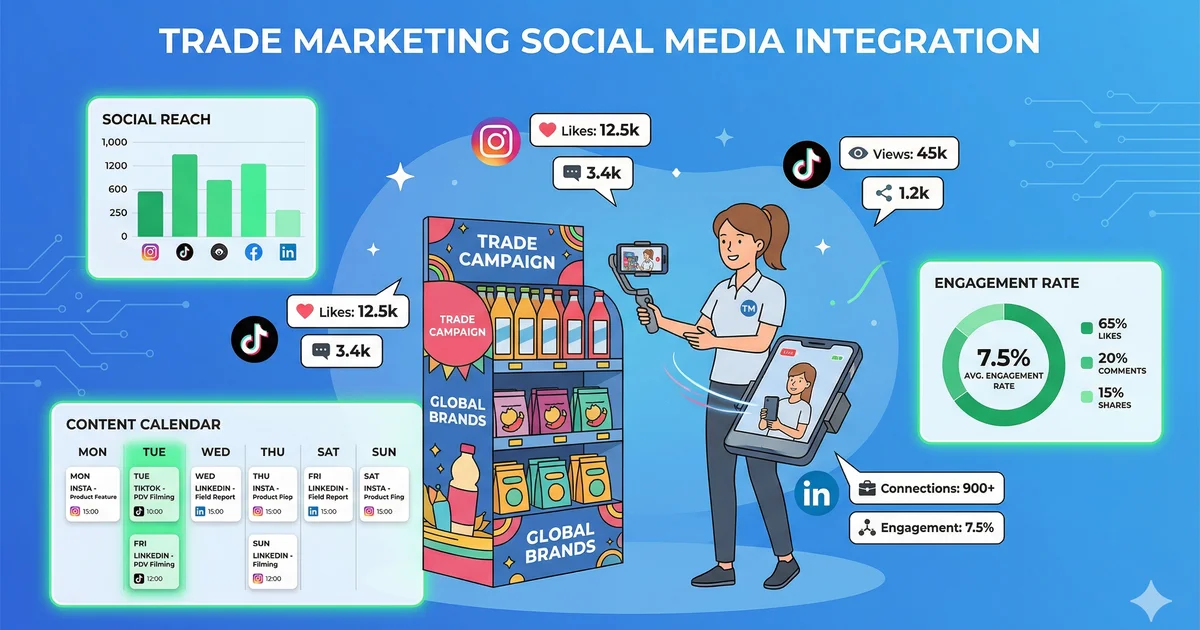
- Content amplification of POS activations. A sampling event that would reach 500 in-store shoppers in a single day can reach 50,000 if the activation is shareable and the field team documents it properly. Trade marketing teams are increasingly responsible for creating not just the activation, but the content strategy around it.
- Retailer partnership positioning. Brands that bring social media audience data to retailer joint business plan (JBP) conversations , showing how their social campaigns drive traffic to specific retail formats , strengthen their negotiating position for gondola space, promotional slots and co-investment.
4) Platform-by-platform: what works for trade marketing
Best for: product aesthetics, lifestyle context, in-store activation documentation and Stories-based promotional announcements. Instagram's visual format aligns naturally with the visual nature of in-store merchandising. Brands that repurpose in-store display photography as Instagram content create a visual loop between physical and digital presence.
TikTok
Best for: product discovery, trial-driving content and viral product moments. TikTok's algorithm allows a product with zero brand following to reach millions of users if the content is genuinely engaging. Several FMCG brands have experienced demand surges that emptied retail shelves within days of a video going viral , a trade marketer's dream scenario that requires the execution infrastructure (field teams, replenishment protocols) to capitalize on.
YouTube
Best for: category education, long-form product demonstrations and sustained brand authority. YouTube content has the longest shelf life of any social platform , a product review or usage tutorial from three years ago still drives traffic. For trade marketers working with complex or premium products, YouTube provides depth that other platforms cannot.
Best for: B2B trade marketing, specifically communicating with retail buyers, category managers and distribution partners. Brands that publish trade marketing insights, category data and execution case studies on LinkedIn position themselves as category authorities, which carries weight in JBP negotiations and buyer relationships.
5) Influencer marketing as a trade marketing amplifier
Influencer marketing has become one of the most effective tools for driving trial and in-store awareness, when executed with the right operational discipline:
- Micro-influencers (10k–100k followers) outperform macro-influencers for trade marketing goals because their audiences are more targeted and their engagement rates are higher. A food micro-influencer with 40,000 followers who reviews a product at a specific supermarket chain reaches exactly the right consumer in the right purchase context.
- Retailer-specific campaigns. Influencer content that explicitly names the retail chain where a product is available ("available at Walmart", "buy it at Carrefour") drives measurable foot traffic. This can be negotiated into co-investment deals with the retailer: the brand brings audiences, the retailer provides promotional space.
- Activation documentation. Influencers present at an in-store activation (sampling, demo, launch event) create organic content that extends the event's reach far beyond its physical audience. This content can be repurposed by the brand for organic social and advertising, generating compounding return on a single investment.
6) User-generated content as trade marketing fuel
User-generated content (UGC) , product photos, reviews, unboxing videos and shopping hauls posted by real consumers , is both a consequence of good trade marketing and a driver of it.
When a display is visually striking enough to be photographed, when an in-store promotion is shareable, when a product experience is satisfying enough to be reviewed, consumers create content that functions as peer-validated advertising. This content:
- Is more trusted than brand-produced advertising (according to Nielsen, 92% of consumers trust peer recommendations over brand advertising)
- Appears in organic search results for product-related queries, extending the brand's digital footprint
- Can be licensed and repurposed for paid social advertising at a fraction of the production cost of studio photography
Trade marketing teams can actively encourage UGC through in-store design choices , photoworthy displays, memorable packaging, exclusive in-store promotions with a social element , and by seeding product to micro-influencers in the target demographic.
7) Integrating social and physical execution: the practical steps
Translating the strategy into operational practice requires four specific coordination mechanisms:
- Unified promotional brief. Every trade promotion should include a social component. The brief sent to the field team and the brief sent to the social media team should reference the same campaign mechanics, timeline and visual assets. If field teams are activating in-store on Monday, the social campaign should launch no later than Friday.
- Field team as content creators. Equip field reps with content guidelines and photo briefs so that exceptional in-store executions are documented and submitted to the trade marketing team for potential social use. An end-cap display that was built perfectly in a flagship store is worth sharing: it sets a visual benchmark and shows retailers and consumers the brand's commitment to execution quality.
- Social listening as execution intelligence. Monitor social mentions that reference specific retail chains or locations. A cluster of negative mentions about stockouts at a specific chain during a promotional period is an execution signal: send the field team to investigate before the promotion window closes.
- Measurement integration. Track social campaign launch dates against sell-out data by region to correlate social spend with physical sales. This analysis is the core justification for continued investment in integrated social-trade campaigns and the data needed to optimize channel mix over time.
8) Measuring social media ROI in trade marketing
The traditional difficulty with social-trade integration measurement is that social media creates awareness that converts in physical retail , a cross-channel attribution problem. The most practical measurement frameworks:
- Pre/post sell-out comparison: compare weekly sell-out rates before and during social campaigns in test vs. control markets (markets with social spend vs. markets without). The difference in sell-out trajectory is an approximation of social-driven incremental volume.
- Geofenced ad click-to-purchase: for campaigns with in-store redemption codes or retailer-specific landing pages, direct attribution is possible: the consumer follows a social link that leads to an in-store coupon with a unique code, providing direct conversion tracking.
- Share of search vs. sell-out correlation: brands that track both their social share of voice and their sell-out data over time consistently find a lagged correlation: a spike in social share of voice precedes a sell-out increase by 1–3 weeks. This lag is the "last mile" that field teams must be ready to fulfill.
9) Conclusion: social media and trade marketing are the same strategy
The divide between social media strategy and trade marketing strategy is organizational , a holdover from when they operated in different departments with different budgets and different KPIs. The consumer has already dissolved that divide. They do not experience your Instagram campaign and your shelf execution as separate brand activities. They experience your brand, holistically, across every touchpoint of their purchase journey.
Brands that integrate these two disciplines , using social to build demand and trade marketing to fulfill it , create a virtuous cycle: better in-store execution generates positive UGC; positive UGC drives pre-store intent; pre-store intent increases sell-out; sell-out improves retailer relationships; better retailer relationships earn better shelf space; better shelf space improves in-store execution.
The tools exist. The consumer behavior is clear. What remains is organizational alignment and execution discipline.
How much does your operation cost?
Find out in 2 minutes.
Download PMR's free guide and learn how to calculate the real cost of each store visit, including travel, salary, and labor charges.
Download free guide