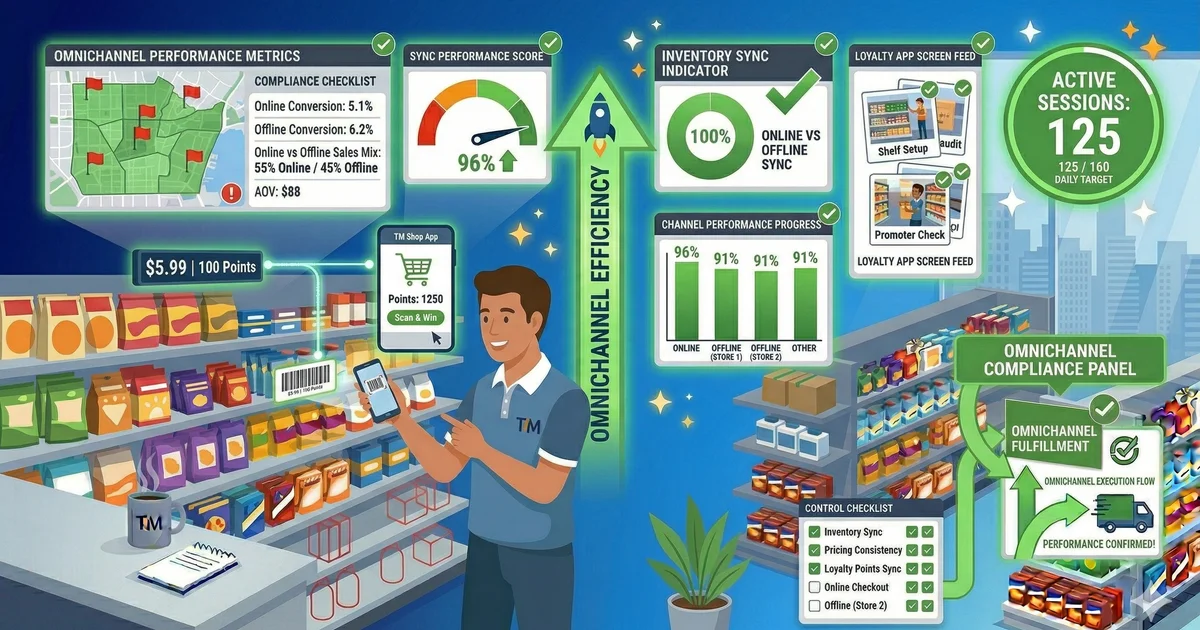
Omnichannel merchandising is no longer a competitive advantage: it is a baseline expectation. Consumers move smoothly between a brand's Instagram page, its e-commerce platform and the physical store shelf, often within the same purchasing journey. A brand that executes differently across these touchpoints loses coherence, trust and sales.
This article breaks down what omnichannel merchandising actually means in execution, what its five operational pillars are, how to integrate physical and digital strategies, and how to measure what matters.
1) What is merchandising in omnichannel marketing?
Merchandising is the set of tactical actions that optimize how products are presented, positioned and promoted to make them more visible, desirable and easy to buy. In a traditional retail context, this means shelf organization, display placement, planogram compliance and in-store signage.
In an omnichannel marketing context, merchandising expands to include every touchpoint where a consumer can interact with a product: the physical shelf, the product listing on a marketplace, the brand's e-commerce site, social media feeds, and app-based promotions.
Trade marketing has always driven physical merchandising execution. What has changed is the scope: a single SKU now needs to be merchandised consistently across four or five distinct environments simultaneously, each with different visual rules, audience behavior and measurement systems.
2) The shift: from single-channel to omnichannel merchandising
A decade ago, most FMCG brands divided their commercial world cleanly: the marketing team owned the digital and advertising side; the trade marketing team owned the physical store. These two worlds rarely intersected, and the consumer experienced them separately.
Today, that division is obsolete. According to Harvard Business Review, more than 73% of consumers use multiple channels during their shopping journey. A consumer might discover a product on Instagram, check reviews on Amazon, compare prices on a retailer's app and then buy the product in-store. At every step, they expect a consistent brand experience: the same price, the same product claims, the same visual identity.
The implications for merchandising are significant:
- A promotional price activated in-store must match the brand's online price or create consumer friction at checkout
- A display theme running in physical stores should be reflected in the brand's social media content that week
- Product images on a digital shelf must match what the packaging actually looks like in-store, not an older version
- Stock levels online and offline must be synchronized to prevent overselling and stockout complaints
Brands that manage these connections deliberately outperform those that treat each channel as a separate silo.
3) The 5 pillars of omnichannel merchandising execution
Effective omnichannel merchandising rests on five operational pillars that must be managed simultaneously:
Pillar 1: Visual consistency
The brand's visual identity , colors, typography, imagery style, product photography , must be consistent across every channel. Inconsistency signals either a fragmented organization or a brand that is careless about detail. Neither inspires confidence. This means establishing a master visual asset library and enforcing version control so that field teams, retail partners and digital agencies all use the same approved materials.
Pillar 2: Unified inventory management
Real-time inventory visibility across all channels prevents the two most damaging omnichannel failures: selling online what is out of stock in the warehouse, and failing to offer click-and-collect because store inventory isn't visible to the digital team. Unified inventory is both a technology problem (system integration) and an operational problem (accuracy of physical stock counts, which field teams verify on every visit).
Pillar 3: Consistent pricing
Price discrepancies between online and in-store on the same SKU are one of the most damaging consumer trust issues in retail. A shopper who finds a product cheaper on Amazon than on the shelf in front of them will either leave the store or question whether the product is authentic. Merchandising best practices require that promotional pricing be activated simultaneously across all channels on the same date , which requires cross-functional coordination between trade marketing, digital and supply chain.
Pillar 4: Contextual content
The right content for each channel is not the same content resized. A physical display communicates through imagery and a short headline , the shopper has three seconds. An e-commerce product page must answer every question the shopper might have, supported by reviews, video and technical specifications. Social media merchandising uses lifestyle imagery and influencer-created content. Each format requires its own content brief while maintaining a consistent brand voice and product claim.
Pillar 5: Execution monitoring
The gap between planned and actual merchandising execution is the single largest source of lost ROI in trade marketing. A display that was never built, a price that was not updated at launch, a product that ran out of stock the first day of a promotion: all represent funded activities that generated zero return. Real-time execution data from field teams closes this gap for the physical channel; digital shelf monitoring tools close it for the online channels.
4) Strategies for integrating physical and digital merchandising
The most effective integration mechanisms currently used by leading FMCG brands:
- Shoppable QR codes in-store: shelf talkers or secondary displays with QR codes that link to product reviews, recipe content, loyalty sign-ups or limited digital promotions. These create a digital data capture point inside the physical store, giving brands direct consumer touchpoints that bypass retailer data ownership.
- Social media as store traffic driver: geofenced social ads that activate when a consumer is near a specific store, promoting an in-store-only offer. Requires coordination between the social media team and the field team to ensure the in-store execution is in place before the digital campaign launches.
- Unified promotional calendar: a single promotional planning document that specifies activation dates, mechanics and creative for both physical and digital channels simultaneously, preventing the common failure where a campaign goes live digitally while the in-store display is still in transit.
- Influencer content seeding into physical stores: when an influencer creates content featuring your product, that same content can be adapted for in-store digital screens, shelf displays or packaging inserts, creating a consistent campaign that spans online and offline at the same time.
5) Technology as an enabler of omnichannel merchandising
Technology does not create omnichannel merchandising; strategy and organizational alignment do. But the right technology stack makes consistent execution scalable across hundreds of stores and digital properties simultaneously.
The core technology requirements:
- Field execution platform: GPS-verified store visits, digital checklists, geotagged photo capture and automated daily reporting. This is the physical channel's equivalent of a digital analytics dashboard: it tells you what is actually happening at the shelf level, not what was planned.
- Digital asset management (DAM): a centralized repository for all approved marketing assets (product images, display templates, promotional graphics) with version control and distribution workflows to retail partners and field teams.
- E-commerce content monitoring: automated tools that audit product pages across marketplaces to detect content drift (outdated images, unauthorized price modifications, missing information) and alert the trade marketing team for correction.
- ERP/OMS integration: real-time inventory synchronization between physical stores, warehouses and e-commerce platforms, the technical backbone of unified inventory management.
6) The field team's evolved role in omnichannel merchandising
Field promoters and merchandisers have always been the execution arm of trade marketing in physical retail. In an omnichannel world, their role gains a new dimension: they become the brand's eyes in the store and the primary source of data connecting physical execution to digital strategy.
Modern field teams equipped with the right tools can:
- Verify that in-store prices match the current digital promotional calendar
- Confirm that QR code materials are correctly installed and functional
- Flag products that are out of stock, triggering automatic replenishment that also adjusts online inventory
- Document display and planogram compliance with geotagged photos that feed directly into the trade marketing dashboard
- Collect competitive pricing data that informs both the pricing team and the digital merchandising team
The field rep who visits 8–12 stores per day is producing structured data that, when aggregated across hundreds of reps, creates a real-time picture of physical execution that no other data source can provide.
7) KPIs to measure omnichannel merchandising success
Measuring omnichannel merchandising requires tracking both channel-specific and cross-channel metrics:
| Channel | Key KPI | What it signals |
|---|---|---|
| Physical retail | Planogram compliance rate | Execution quality in-store |
| Physical retail | On-shelf availability (OSA) | Stock health at POS |
| E-commerce | Share of search | Digital shelf visibility |
| E-commerce | Content score per listing | Digital merchandising quality |
| Cross-channel | Price consistency rate | Channel pricing alignment |
| Cross-channel | Customer lifetime value | Omnichannel retention impact |
The most important cross-channel metric is promotional uplift by execution compliance level: comparing sell-out in stores with 90%+ compliance to stores with below 60% compliance during the same promotional period. This single analysis demonstrates the ROI of proper field execution and justifies continued investment in the field team.
8) Conclusion: merchandising without borders
Omnichannel merchandising is the practice of ensuring that your brand is visible, available and persuasive wherever your consumer decides to engage with it, whether that engagement happens in a supermarket aisle, a marketplace search result or an Instagram story.
The brands winning this game are not necessarily those with the largest budgets. They are the ones with the tightest execution discipline: consistent assets, unified inventory, aligned pricing and field teams that close the gap between strategy and reality at every point of sale.
How much does your operation cost?
Find out in 2 minutes.
Download PMR's free guide and learn how to calculate the real cost of each store visit, including travel, salary, and labor charges.
Download free guide